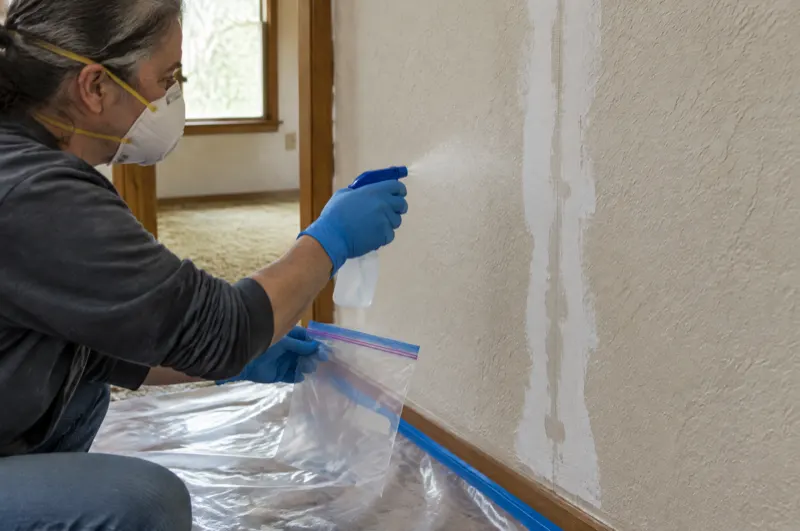
If your home is older and you're about to cut, sand or tear out walls or a textured ceiling, have the joint compound and texture sampled by a trained professional first. Most single homes are exempt from San Diego County's survey rule, but the exemption isn't a test result.
The parts of a wall that matter
A finished wall has four layers worth knowing about: the gypsum board, the paper tape over the seams, the joint compound (mud) that covers the tape and screw holes, and any texture sprayed or troweled over the top. Ceilings may also have a sprayed "popcorn" or acoustic texture.
Remodels and repairs add patches over the years, so one room can hold materials from several decades.
What EPA says can contain asbestos
EPA's list of building materials that may contain asbestos includes "textured paint and patching compounds used on walls and ceilings," along with vinyl floor tile, sheet-vinyl backing and adhesives, and roofing and siding shingles (EPA).
EPA's advice to homeowners is practical: material in good condition that won't be disturbed can be left alone; remodeling is what disturbs it; sampling should be done by a trained professional; and "if in doubt, treat the material as if it contains asbestos and leave it alone" (EPA).
Why a home's age isn't a reliable test
Online guides disagree on cutoff years, and none of them can tell you what's in your wall. A house built in one decade may have been patched with older product, or textured later. San Diego County's asbestos rule makes the same point in its own way: where the rule applies, the survey is required "regardless of the age of the facility" (SDAPCD Rule 1206).
San Diego County: what Rule 1206 covers
San Diego County Air Pollution Control District Rule 1206, effective November 15, 2017, governs asbestos during renovation and demolition. Where it applies, a facility survey for asbestos is required before work, and notifications are due 10 working days before work starts (SDAPCD Rule 1206).
It does not apply to renovation or demolition of a residential building with four or fewer dwelling units, or a single mobile or manufactured home, unless the buildings form an installation or are used for commercial, institutional, public or industrial purposes. It also exempts renovations disturbing less than 100 square feet in a year (SDAPCD Rule 1206). The federal asbestos NESHAP has a matching exclusion for residential buildings of four or fewer units (EPA).
So for most single-family remodels in Pala, Fallbrook or Valley Center, no air-district survey is required. That tells you about paperwork. It doesn't tell you whether the mud contains asbestos.
Temecula and Murrieta: a different air district
Western Riverside County falls under the South Coast Air Quality Management District, whose Rule 1403 has its own survey requirements and exemptions, reported to include an owner-occupant renovating their own single-unit home. We couldn't confirm the current text directly, so check South Coast AQMD's asbestos page before relying on it.
Disposal has limits on that side too: Riverside County's landfills don't accept waste containing more than 1% friable asbestos (Riverside County).
How testing works
- Don't sand, scrape or cut the area first. That's the disturbance you're trying to avoid.
- Have a trained professional take samples of each different material: joint compound, texture, and patches that look different.
- Samples go to an accredited lab. Results list each sample separately.
- Keep the report. Your contractor, and your hauler, may ask for it.
Lead paint is a separate question. In homes built before 1978, EPA's Renovation, Repair and Painting rule requires certified firms and lead-safe practices for paid work that disturbs painted surfaces.
What happens to the debris after the results
If the results are negative, the drywall is ordinary construction debris and can go in a normal haul. If any material is positive, it isn't a junk-hauling job: removal goes to a licensed abatement contractor, and the waste goes to a facility permitted for it.
| Question | Why it matters |
|---|---|
| When was the house built and last remodeled? | Tells you how many layers of patching and texture to expect. |
| How much wall or ceiling will be disturbed? | Rule 1206's 100 sq ft threshold, and the size of the job. |
| Is there texture or popcorn on the surface? | EPA lists textured paint and patching compounds. |
| Who will take the samples? | EPA recommends a trained professional. |
| Are results in hand before demolition starts? | Avoids stopping a job halfway with debris on the floor. |
Sources
- EPA, Learn about asbestos: materials that may contain asbestos
- EPA, Protect your family from exposures to asbestos: homeowner guidance on sampling and remodeling
- San Diego County APCD Rule 1206: survey and notification; residential exemption
- EPA, Asbestos NESHAP: federal residential exclusion
- South Coast AQMD, asbestos demolition and renovation: Rule 1403 (verify current text)
- Riverside County, accepted waste: landfill limit on friable asbestos
- EPA, Renovation, Repair and Painting rule: pre-1978 lead paint
Rules and facility policies change. These links were checked on October 28, 2026; confirm with the agency or facility before you rely on them.