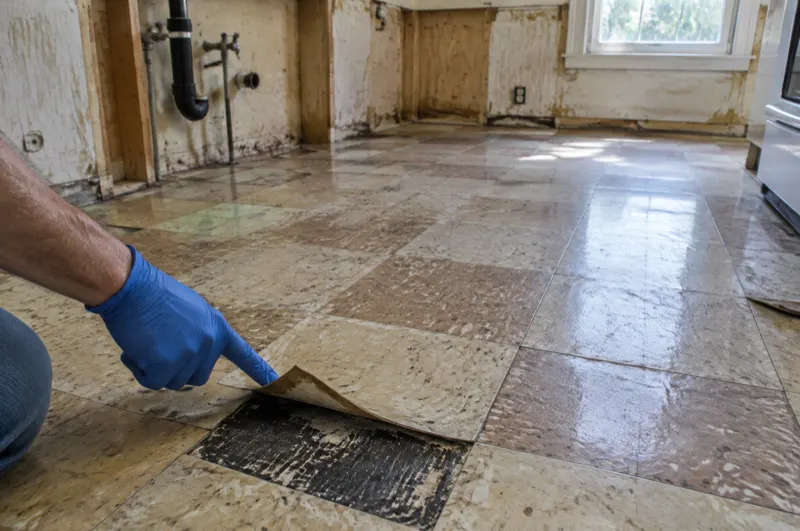
Before pulling up flooring in an older home, check what's under the top layer. Old vinyl tile, sheet-vinyl backing and the adhesive under them are on EPA's list of materials that may contain asbestos, so have them sampled first. Then sort the rest by material: carpet and pad, tile and mortar, vinyl and laminate, and wood.
A floor is layers
From the top down: the covering you walk on, the adhesive or mastic holding it, any underlayment, and the subfloor (plywood or the concrete slab). Older homes often have a second floor buried under the current one, such as sheet vinyl under laminate or tile over old vinyl. Lift a corner in a closet or at a threshold to see what's there.
Which layers can be a concern
EPA lists vinyl floor tiles, the backing on vinyl sheet flooring, and adhesives among materials that may contain asbestos (EPA). When sampling, the tile and the adhesive under it are separate materials and should be sampled separately.
| Layer | Examples | Test before disturbing? | Pile |
|---|---|---|---|
| Carpet and pad | Wall-to-wall carpet, foam pad, tack strip | No | Carpet and pad |
| Laminate and modern vinyl plank | Click-lock planks, foam underlayment | No, unless older vinyl is underneath | Vinyl and laminate |
| Old vinyl tile | 9-inch squares, older 12-inch tiles | Yes | Hold until results |
| Sheet vinyl | Roll vinyl with a felt or paper backing | Yes, for older floors | Hold until results |
| Adhesive and mastic | Black or dark brown glue under tile | Yes | Hold until results |
| Ceramic and porcelain tile | Tile with thinset or mortar | No | Tile and mortar |
| Hardwood and engineered wood | Nailed or glued planks | No | Wood |
When to test and who should sample
EPA advises that remodeling is what disturbs asbestos-containing material, that sampling should be done by a trained professional, and that when in doubt you should treat the material as if it contains asbestos and leave it alone (EPA). Scraping, sanding and breaking tile are the steps to avoid until results are in.
The air-district rules for San Diego and Riverside counties, including the single-home exemption in San Diego County's Rule 1206, are covered in our drywall testing guide.
Sorting by material for haul-away
San Diego County lists carpet and carpet padding, drywall, wood, and brick, masonry and tile among recyclable C&D materials, and certified mixed facilities accept commingled loads (County C&D FAQ). Sorting still helps: it speeds loading and keeps heavy tile from crushing bags of lighter material.
- Carpet and pad: cut into strips about 3 feet wide, roll and tape. Bundle tack strip with the sharp side in.
- Tile and mortar: sturdy buckets or heavy bags filled about halfway. Tile is an inert, like concrete.
- Vinyl plank and laminate: stack flat in bundles; bag the foam underlayment.
- Wood: stack with nails bent over or pointing down.
- Baseboards and trim: in a pre-1978 home, painted trim may carry lead paint; EPA's Renovation, Repair and Painting rule applies to paid work that disturbs it (EPA RRP).
Staging for pickup
- Keep materials dry. Wet carpet and pad weigh far more and are harder to carry.
- Stack by the door or in the garage, not on new flooring.
- Set aside spare boxes of new flooring so they don't get hauled by mistake.
- Keep anything waiting on test results separate and marked.
What doesn't go in the load
Flooring that's waiting on test results or that tested positive, and containers of adhesive remover, solvents and leftover finishes. San Diego County treats paint, stains and solvents as household hazardous waste, with drop-off options including PaintCare sites (San Diego County HHW).
Sources
- EPA, Learn about asbestos: vinyl tile, sheet-vinyl backing, adhesives
- EPA, Protect your family from exposures to asbestos: sampling and remodeling guidance
- County of San Diego, C&D Recycling Ordinance FAQ (July 2022): recyclable materials, mixed facilities
- EPA, Renovation, Repair and Painting rule: pre-1978 lead paint
- County of San Diego, household hazardous waste: paints, stains, solvents
Rules and facility policies change. These links were checked on October 28, 2026; confirm with the agency or facility before you rely on them.