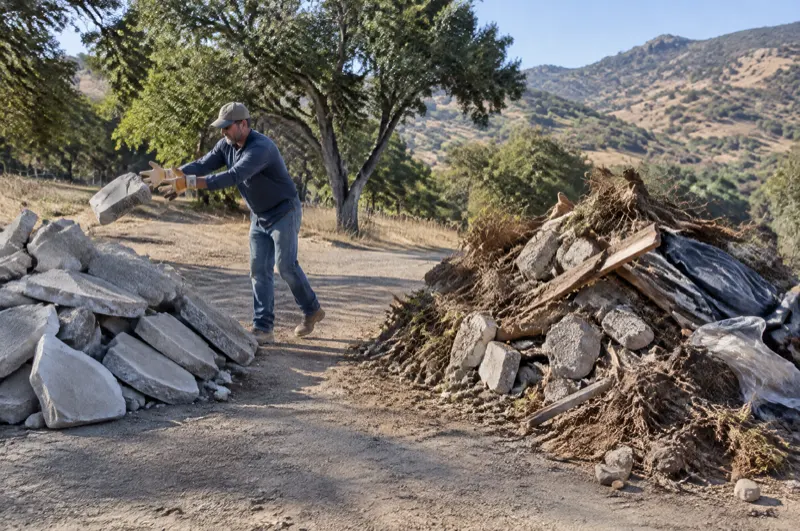
Keep broken concrete, brick and block in their own pile, away from dirt, wood, trash and plastic, and measure the pile in feet so it can be priced by weight. Clean concrete can go to an aggregate recycler; a mixed pile usually can't.
What counts as concrete debris
For hauling and recycling, "concrete" means more than slabs. San Diego County groups asphalt and concrete, dirt and rock, and brick, masonry and tile together as inert materials (County C&D FAQ). In a typical home project that covers:
- Patio, walkway and pad slabs, broken into pieces
- Footings, steps and post footings
- Cinder block, brick and pavers
- Broken ceramic tile and mortar
Mixing inerts with each other is usually fine. Mixing them with wood, trash or soil is what turns a recyclable load into a disposal load.
Why keeping concrete separate matters
Recyclers crush clean concrete into aggregate for base rock and fill. Facilities commonly price clean, source-separated concrete differently from mixed loads, and many limit how much dirt, trash, wood, wire mesh and protruding rebar a load can carry. Criteria differ from one facility to the next, so the receiving site has the final word.
Some projects also have rules. Under California's CALGreen code, covered new construction, demolition and certain additions and alterations must recycle or salvage at least 65% of their nonhazardous construction debris (CalRecycle). In unincorporated San Diego County, covered projects must divert 65% of their C&D material and at least 90% of their inerts (County C&D FAQ). A patio removal on its own usually isn't a covered project, but concrete that comes out as part of a permitted addition may be.
Clean or mixed: what to keep out of the pile
| In the pile | Keep with the concrete? | Why |
|---|---|---|
| Slab pieces, block, brick, pavers | Yes | All inerts; they recycle together. |
| Broken ceramic tile and mortar | Usually | Grouped with masonry as an inert; ask the facility. |
| Wire mesh | Ask first | Some recyclers limit it; it also slows loading. |
| Rebar sticking out of pieces | Ask first | Some sites take concrete with rebar, others want it cut back. |
| Soil and base rock | Keep apart | Heavy, and many sites price dirty concrete differently. |
| Wood forms, roots, plastic sheeting, trash | No | Turns the load into mixed debris. |
| Painted or sealed concrete, oil-soaked pads | Ask first | Coatings and residues may not be accepted. |
Rebar, mesh and anchors
Reinforced slabs come apart in pieces tied together by wire mesh or rebar. Tell your hauler about it before the visit rather than cutting it yourself. Cutting steel out of broken concrete takes the right tools and eye protection, and it's often faster for the crew to do it as they load.
On the Riverside County side, Ewles Materials in Murrieta is listed as accepting clean concrete and concrete with rebar (Riverside County C&D recyclers list). Acceptance at other sites varies, which is why it's worth asking before the pile is built.
Concrete is heavy: estimate by weight, not by eye
Normal-weight concrete runs about 145 pounds per cubic foot in federal design references, and 150 pounds per cubic foot is a common value for reinforced concrete (FHWA). That's why a small pile can fill a truck's payload while the bed still looks half empty.
To estimate, multiply length by width by thickness in feet:
- 10 ft × 10 ft patio at 4 inches (0.33 ft) = about 33 cubic feet = roughly 4,800 to 5,000 pounds
- 12 ft × 15 ft patio at 4 inches = about 60 cubic feet = roughly 8,700 to 9,000 pounds
- The same 12 × 15 patio at 6 inches = about 90 cubic feet = roughly 13,000 to 13,500 pounds
Broken pieces take up more room than the solid slab did, but they weigh the same. Give your hauler the slab's original size and thickness, not the size of the pile.
Staging broken concrete for pickup
- Pile it on a hard surface the truck can reach, or as close to one as practical. Every wheelbarrow trip across a lawn adds time.
- Keep pieces to a size two people can lift if you're breaking it yourself.
- Don't stack it against fences or walls; the weight can push them over.
- Leave a clear path at least as wide as a wheelbarrow, and mark sprinkler heads in the way.
- Take one photo of the whole pile with a person or a tape measure in it for scale.
Sources
- FHWA, Appendix C: unit weight of concrete: about 145 lb/ft³ normal-weight; 150 lb/ft³ common for reinforced
- County of San Diego, C&D Recycling Ordinance FAQ (July 2022): inert categories; 65% and 90% inert diversion
- CalRecycle, CALGreen construction waste model: 65% diversion for covered projects
- Riverside County C&D debris recyclers list: Ewles Materials, Murrieta
- Riverside County, accepted waste at landfills: concrete and asphalt accepted at County landfills
Rules and facility policies change. These links were checked on October 28, 2026; confirm with the agency or facility before you rely on them.