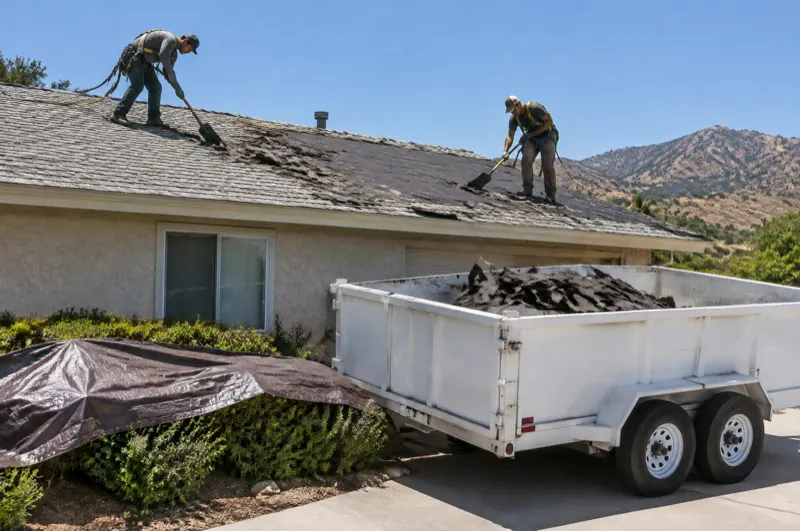
Count the roof in squares (100 square feet each), multiply by about 200 pounds per square for three-tab or 240 for laminate shingles, then multiply by the number of layers. A 20-square laminate roof with one layer comes to roughly 4,800 pounds of debris.
What a roofing square is
Roofers measure in squares. One square covers 100 square feet of roof surface. A roof's surface area is larger than the house's floor area because of pitch and overhangs, so the most reliable count comes from your roofer's estimate or invoice, which lists squares directly.
Weight per square by shingle type
IKO, a shingle manufacturer, publishes tear-off estimates that include underlayment, nails and debris (IKO):
| Shingle type | Shingles alone, per square | Tear-off estimate, per square |
|---|---|---|
| Three-tab | up to about 190 lb | about 200 lb |
| Laminate (architectural) | under 230 lb | about 240 lb |
| Premium / designer | 230–450 lb | about 300 lb (estimate) |
IKO's own example puts a 15-square three-tab tear-off at about 3,000 pounds.
Layers, underlayment and decking
Each layer of shingles left on a roof adds its full weight to the tear-off. Two layers of laminate shingles weigh roughly twice as much as one. If damaged decking is replaced, the old plywood or skip sheathing adds more, along with flashing, drip edge and old vents.
Worked estimates for common roof sizes
| Roof size | Three-tab (~200 lb/sq) | Laminate (~240 lb/sq) | Premium (~300 lb/sq) |
|---|---|---|---|
| 15 squares | 3,000 lb | 3,600 lb | 4,500 lb |
| 20 squares | 4,000 lb | 4,800 lb | 6,000 lb |
| 25 squares | 5,000 lb | 6,000 lb | 7,500 lb |
| 30 squares | 6,000 lb | 7,200 lb | 9,000 lb |
Double the figure for two layers. These are estimates; wet shingles and extra decking weigh more.
Tile and other roofing
Concrete and clay tile roofs are far heavier per square than asphalt, and recycling options are thin. San Diego County even uses roofing tile as its example of a material for which a recycling exemption may be granted because no facility is available (County C&D FAQ). For a full tile roof, get the square footage to your hauler early.
Where tear-off shingles go
CalRecycle describes the markets for recycled asphalt shingles as limited, mainly hot-mix asphalt, aggregate base and new shingles made from clean material. Tear-off shingles are usually mixed with nails, mastic, underlayment and decking, which makes recycling harder. CalRecycle estimated about 687,000 tons of asphalt shingles were landfilled in California, based on 2018 data (CalRecycle).
In practice, most tear-off goes to a certified mixed C&D facility or a landfill. Riverside County's landfills accept roofing as construction waste (Riverside County).
A note on older roofs: CalRecycle reports asbestos was used in some roofing materials until the 1980s; in the 2008 statewide sampling it turned up in one of 191 roofing samples, a roofing mastic (CalRecycle). Built-up tar roofs and old mastics are the ones to ask about.
Nail cleanup checklist
- Lay tarps on the driveway and over planting beds below the eaves before tear-off starts.
- Keep the drop zone clear of cars, pets and kids until it has been swept.
- Run a rolling magnet over the driveway, walkways and the lawn edge, in overlapping passes.
- Check gutters and the base of walls, where nails collect.
- Do a second magnet pass the next day in good light.
Sources
- IKO, What size dumpster for a roofing job: per-square tear-off weights
- CalRecycle, asphalt shingle recycling and roofing characterization: markets, tonnage, asbestos sampling
- County of San Diego, C&D Recycling Ordinance FAQ (July 2022): roofing tile exemption example
- Riverside County, accepted waste: roofing accepted at landfills
Rules and facility policies change. These links were checked on October 28, 2026; confirm with the agency or facility before you rely on them.